From August 1961 to November 1989, the Berlin wall stood between East Berlin and West Berlin. The falling of the Wall was for me one of the most important moments of the twentieth century. To me it has been a symbol of the fall of totalitarianism and the triumph of the human spirit. During this month in Berlin, my perspective expanded. I was able to feel the pain that the existence of the Wall had on the lives of the Berliners, families and friends separated overnight, some not to see each other again for 18 years, if they lived that long, if their lives had not become so unconnected. When my friend spoke of having left the Russia in the ‘90’s “for political reasons,” she mentioned Gorbachev and a look of reverence came to her face. “He was Russian Abraham Lincoln. Lincoln greatest American President.” That was perhaps my most candid conversation with someone who had lived on the other side of the Iron Curtain.
Wednesday, July 28, 2016
This morning when I got up, I wondered if I should go see the memorial to the Wall. I had been to East Side Gallery (twice) and wondered what it could add. But I hadn’t anything planned for the day, and Google Maps told me it was only a thirty minute walk and I’m trying to walk at least five miles a day, so I said why not. I took the route that didn’t re-trace much of anything I’ve already walked so that added the adventure of seeing new things and the ever-present possibility of getting lost. I can follow the transit guidance quite well. It is the walking directions that often confuse me. The day was noticeably cooler then the previous three days. Sunday and Monday were quite hot. I stopped at a bakery and bought a delicious roll, justifying the carbs by my walking and wondering how the small shops stay open with cheap prices and what appears to be low volume. I passed a beautiful classical Evangeliste (Lutheran) church called Zionskirche. I turned right on Ackerstr. And as I reached the corner at Bernauer Straβe, I saw a long, rectangular simple granite memorial. I walked the length and stepped behind it and saw a section of the wall and a watchtower and wondered, “Is that all there is?” (Understand that on the one hand I’m adventurous and on the other hand I don’t always plan ahead or in this case read ahead).
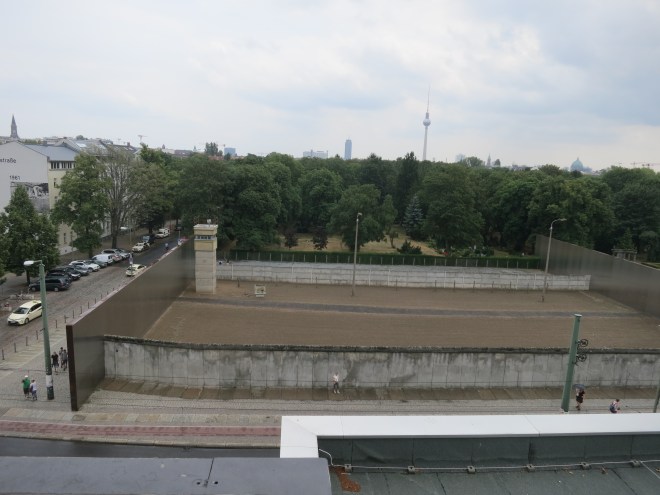
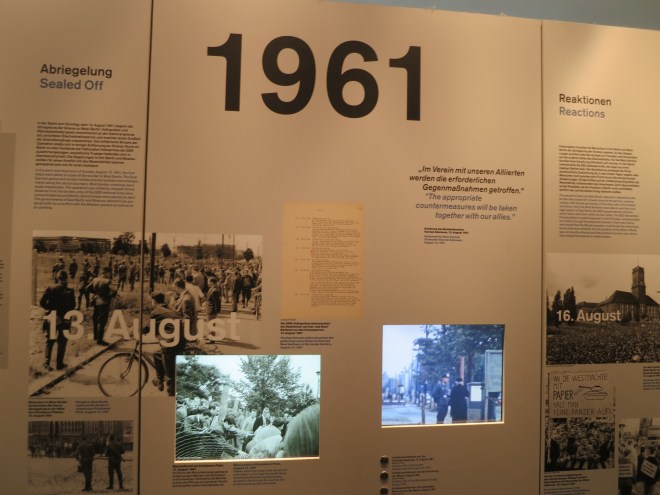
Then I noticed a building across the street that turned out to be a wonderful museum of life before the wall, life during the wall and the coming down of the wall. It was very well done. I really urge anyone who goes to Berlin (or who is from Berlin) to visit.
But that’s not all. There’s more‼! Back across the street to the side I was on before, for several blocks there are more sections of the wall and open spaces. In an eerily surreal fashion rebar (reinforcing steel bars) have been placed parallel to the sections of the wall facing the street. Forty yards or so behind them are sections of the wall.
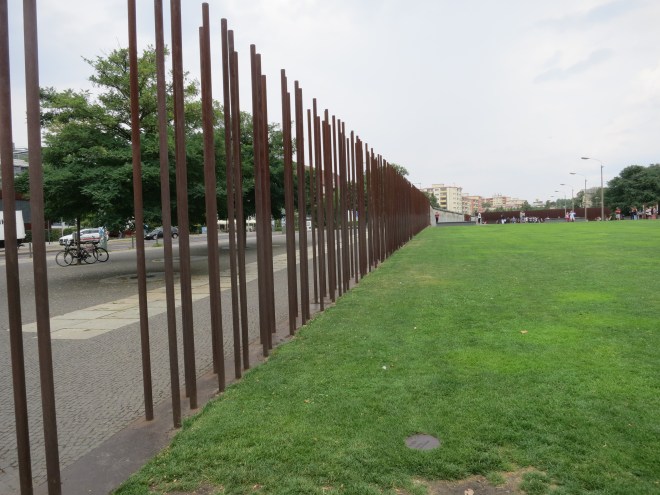
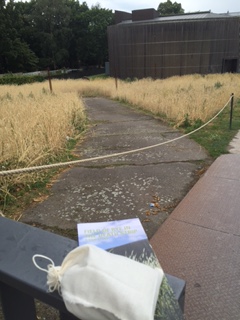
The wall itself is not thick. The reason is that the distance between the two walls is known as “The Death Strip.” At Bernauer Strasse 4, 10115 Berlin, a part of this long area dedicated to the Wall, there is “The Rye Field at the Chapel of Reconciliation.” After the Wall was torn down, this space was returned to it’s former use and rye was planted. There is a good chance I would have not paid much attention to it or contemplated much about it but as I reached it, what had been a light mist became a heavy rain. I sat at a table and waited until the rain abated. As I was leaving I made a small donation and the friendly woman at the desk thanked me and handed me a small sack with rye. The said it had a recipe in it. I said maybe I’ll try to make some rye bread. She laughed and said, not enough to make a bread. Maybe a cookie I said.
In between the wall which is close to Bernauer Strasse is now mostly green area, with stations that give information and sculptures.
There is little more symbolic of the failure of totalitarianism and the victory of the human spirit than the rise and fall of the Berlin Wall. A Russian friend here. Now a Berliner, said Gorbachev is Russian Abraham Lincoln.
Earlier
The East Side Gallery is a much different experience. I think I went my fourth day. The colorful graffiti represents a celebration of the joy and freedom of expression after the wall came down.
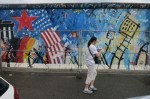
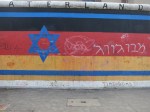
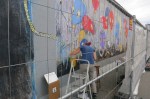
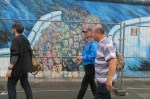
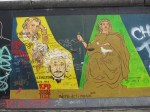
Here there was no Death Strip. The river Spree was the barrier. It’s wonderful, but it doesn’t capture the experience of what life must have been like when the Wall was up. What really enhanced the experience was, after I had walked up and down the length of the East Side Gallery was going to the Museum of the Wall. As I initially approached the beginning of the East Gallery, a young girl who spoke English in an Italian accent handed me a flyer for the Museum of the Wall. I learned that for 6,50€ (senior discount price) I would get admission, 1/2 off at the restaurant (certain items) and a piece of the wall (my sister had given me a piece of the wall long ago). I walked all the way to the end, kept going and went in to the S train station at the stop before the one for the East Side Gallery and had a cold brew from Starbucks one of those you gotta have at least once in Berlin, Currywurst. It was good but not over the top good like the Döner chicken thing I had yesterday at Alexander Platz. I walked back along the East Gallery, taking many, many photos of wall sections and then came back to the beginning. I decided to try the Museum of the Wall, assuming it would be cheesy but what the heck. I walked up the stairs to the museum, paid, got a piece of the wall and entered the exhibition. I went in to the exhibition and was immediately taken. I had lived through the entire period and read the newspaper and watched the news reels and later the television news, from the end of the war, and the division of German, to the “Ich bin ein Berliner” speech of JFK in Berlin to the building of the Wall, and how easy it was to despise the puppet WalterUlbricht, to the tearing down of the wall. The exhibition was so tastefully informative, emotional and entertaining. I didn’t really appreciate that families and friends were separated overnight and then for 18 years. The last exhibit room had a video of a concert at Potsdamer Platz (where yesterday I saw Bastille Day on Independence Day at the Cinemax at the Sony Center [not knowing of the horror that would come on Bastille Day 2016)) with Pink Floyd, joined by Cindy Lauper and Bryan Addams and others, singing “Just another brick in the wall.” “We don’t want no thought control.” The fall of the Berlin Wall was one of the most important and memorable events of my lifetime (there have been many but I’ve lived a while) .It was a very powerful experience.
My video of the concert video is at this link: https://www.youtube.com/watch?v=FP5b7fPPaVE
And for what must be the full 8+ minute version
https://www.youtube.com/watch?v=5e7X9m9QC3k
but it doesn’t show the wall they made coming down. I haven’t been able to track down the full version. The one at the museum shows the wall built for the concert brick by brick coming down.
My guess is most people don’t go to the Wall Museum because they think it is a tourist trap, as I did but I went anyway. Do it! The flyer proclaiming “The man who changed our world MIKHAIL GORBACHEV presents The Wall Museum East Side Gallery. And sadly Gorbachev is, I read, very unpopular in Russia.
http://www.thewallmuseum.com/en/
I passed a plaque in the Jewish section that had a quote from Martin Luther King made in a sermon at a Baptist church on the evening of September 13, 1964 when he was on an official visit to Berlin:
“No man-made barrier can erase the fact that God’s children live on both sides of the Wall.” Those in attendance responded by singing verses of the hymn inspired by the story of Exodus of the Jewish people from Egypt, “Let My People Go.”
I returned to the Wall Museum for just one reason. To buy pieces of the Wall. They are for my children and grandchildren and are the only presents I bought on this trip.
 Marc's Berlin Diaries